


Swanage Railway has announced the six locomotives which will star in its three-day Autumn Steam Gala from Friday 12 September to Sunday 14 September 2025.
The six locomotives, which date from the 1890s to the 1940s, will run along the whole nine-mile length of the Swanage Railway in the Isle of Purbeck.
Visiting locomotives
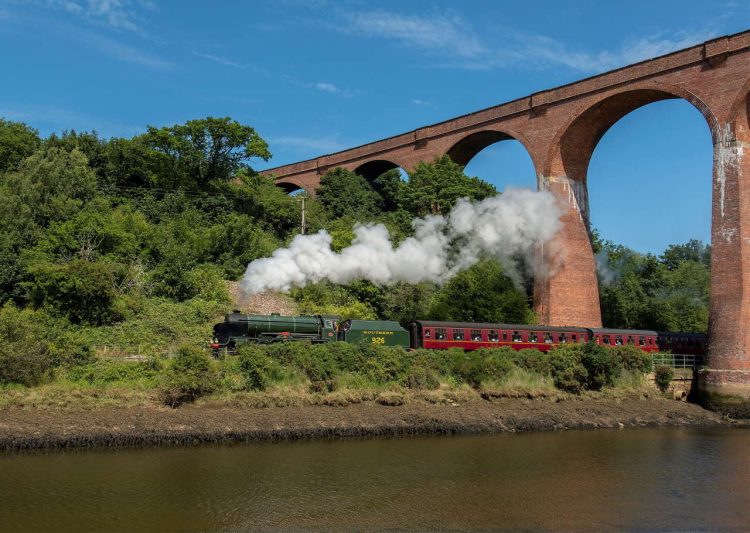
1930s Southern Railway ‘Schools’ class express steam locomotive No. 926 ‘Repton’ will be hauling trains in Dorset for the first time since the Second World War when it was based in Bournemouth.
The ‘Schools’ class of steam locomotives did not visit the Isle of Purbeck branch line to Corfe Castle and Swanage in pre-preservation days. Richard Maunsell designed them to haul mainline express trains across the south of England from the 1930s to the 1960s.
Based at Bournemouth after being built at Eastleigh in 1934, Schools class No. 926 ‘Repton’ was built at Eastleigh in 1934 and then based at Bournemouth. It is appearing at the Gala courtesy of the North Yorkshire Moors Railway, where it recently starred at its home Gala.
1920s S15 class freight locomotive No. 30506, which will be the first S15 to visit the Isle of Purbeck in more than two decades.
Robert Urie designed the ‘S15’ class steam locomotives, which hauled heavy freight trains between London and Southampton and Exeter from the 1920s to the 1960s. S15 class No. 30506 is owned by the Urie Locomotive Society and is visiting the Gala from Hampshire’s Watercress Line.
Home fleet
Swanage Railway’s home fleet of four preserved steam locomotives will haul passenger and demonstration freight trains during the Gala, subject to availability.
The four locomotives are:
- Victorian 1893 London and South Western Railway T3 No. 563
- late 1920s Southern Railway U class No. 31806
- two 1940s Southern Railway Battle of Britain class Bulleid Pacific express steam locomotives – No. 34070 ‘Manston’ and No. 34072 ‘257 Squadron’.

Gala attractions
Following last year’s cancellation of the Autumn Steam Gala, the Railway is planning a busy timetable at this year’s event.
Passenger trains will operate between Swanage, Harman’s Cross, Corfe Castle, Norden and four miles beyond to the River Frome, within sight of Wareham.
The Gala will also include nostalgic demonstration freight trains, evening ‘beerex’, and night trains between Swanage, Corfe Castle and Norden.
Visitors will also be able to ride in the brake van of a demonstration 1950s freight train.

“We are delighted to be able to offer enthusiasts and the general public such a wide variety of steam locomotives at work through the beautiful Isle of Purbeck countryside, past the dramatic ruins of Corfe Castle and beyond Norden to Furzebrook and the River Frome within sight of Wareham.
“No. 926 ‘Repton’ and No. 30506 are wonderful and fascinating examples of Southern Railway steam locomotive design through the 1920s and the 1930s – ‘Repton’ being designed for express passenger train work while No. 30506 was designed for hauling heavy freight trains.
“One of the class of steam locomotives named after English public schools, ’Repton’ was based at Bournemouth from the late 1930s and operated from there during the Second World War. The coming of peace saw ‘Repton’ used on inter-regional express passenger trains before it was withdrawn from British Railways at Basingstoke at the end of 1962.
“The S15 class steam locomotives proved to be strong and capable locomotives with No. 30506 hauling freight trains between London and Southampton, as well as from the capital to Exeter, from the 1920s until it was withdrawn from traffic in 1964.”
Gavin Johns, Swanage Railway Company chair and volunteer signaller




Responses
Anyone know what route the Repton 926 will take from Yorkshire to swanage? Thanks